5 · Diabetes, Obesity, and Iron
We're in the midst of an obesity epidemic, and diabetes is strongly on the rise as a consequence. Could there be an iron connection to both of these?
There's certainly an association between iron and obesity. In a group of Japanese people, average age 58, ferritin was significantly correlated with visceral fat, subcutaneous fat, liver fat, and insulin resistan68ce.lx Similar results were seen in a Mexican popula69tion.lxi
Obesity is characterized by insulin resistance, the relative inability of cells to respond properly to insulin, a hormone secreted by the pancreas. Insulin promotes the uptake of glucose (sugar) from the blood into cells, and it prevents the release of fat from fat cells. When insulin resistance goes on long enough, type 2 diabetes can result.
In obesity, iron levels increase, insulin sensitivity and adiponectin levels decline, and excess calories are then shunted to fat cells. This is accompanied by increased inflammation and oxidative stress.
What causes iron levels to increase? For one thing, aging. As we’ve noted, the body has no regulated way to rid itself of excess iron; bleeding is the only natural way to lower iron stores – and this isn’t regulated. The body “wants” to hang on to all the iron it can get, because in evolutionary terms, iron is a scarce resource, and the downside of excess iron usually only occurs at an older age, when evolutionary pressures are relaxed.
Older age is associated with obesity, insulin resistance, oxidative stress, and inflammation – and with excess iron.
Refined carbohydrates such as flour have taken much of the blame for the obesity epidemic, maybe deservedly so. But other countries, such as France and Italy and the Scandinavian countries, eat plenty of foods with flour in them, such as bread and pastries and pasta, and have much less obesity than the U.S. In the U.S., flour is iron-fortified, but not in those other countries. Perhaps iron is the reason for the much greater rate of obesity in the U.S.
Furthermore, a fad for gluten-free products has become strong in recent years, with many people saying that gluten, one of the components of wheat, makes them ill, and having success at curing their ills when they stop eating gluten. Here again, iron may be a factor. As we'll see when we look at infections, bacteria love iron and require it to grow and reproduce. The type of iron added to flour and other refined carbohydrates is free iron, which is instantly available to bacteria, much more so than the iron in meat, which is locked down in the heme molecule. The gut contains billions of bacteria, and feeding them iron could be expected to increase that number as well as change the mix of bacterial species, leading to dysbiosis and gut health problems. Perhaps the real reason that some people feel better when they give up gluten is that they're getting much less iron in their gut, so less is available to feed bacteria.
Adiponectin70
Adiponectin is a hormone that regulates appetite, and also has a number of healthful effects. In obesity, adiponectin declines, and this is thought to be behind some of the illnesses, such as cardiovascular problems and diabetes, associated with obesity.lxii
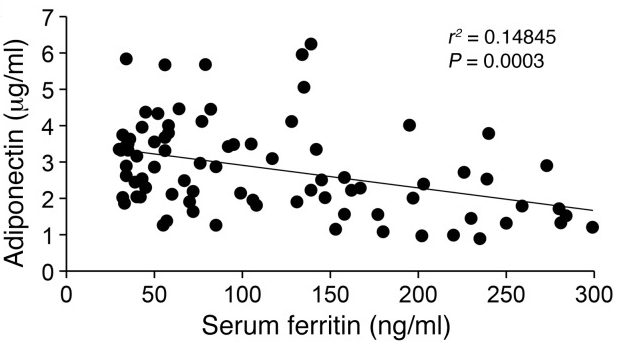
Laboratory animals fed a high-iron diet have decreased adiponectin, and fat cel72ls treated with iron have lower secretion of this hormone. In humans, ferritin (iron in the body) is increased in obese diabetic subjects, and this lowers adiponectin.lxiii See chart above.
Phlebotomy (bloodletting) lowers iron stores and increases insulin sensitivity.lxiv
In the case of obesity and diabetes, we're faced with a chicken-and-egg problem: which comes first, increased iron leading to obesity and diabetes, or obesity and diabetes leading to increased iron?
The facts on this matter are not firmly established, and it appears to this writer that both of these could be the case depending on the person, or even in the same person. Since getting rid of excess iron leads to better insulin sensitivity, which comes first may not matter, as it may be iron that is causing most of the metabolic damage. In other words, merely by depleting excess iron, or by preventing excess iron in the first place, much of the metabolic damage of obesity may be undone or prevented. Diabetics who do nothing but lower their iron stores may see increased insulin sensitivity, and this may in turn treat or mitigate their diabetes.
Besides creating the metabolic conditions for increased iron, another way to acquire excess iron is through iron-adulterated food. All flour, corn meal, and rice in the U.S. is required by law to be fortified with iron.
Our food is poisoning us with iron.73
Other sources of iron include multivitamins and iron-fortified breakfast cereals. From 15 to 20% of the adult population in the U.S. take iron supplements.lxv Practically everyone eats cereal.
Certain foods also accelerate iron absorption through regulation of hepcidin, the hormone that controls iron absorption. For instance, eating refined carbohydrates and sugar, which are associated with obesity, alters iron metabolism, leading to increased iron uptake, with the consequent oxidative stress leading to insulin resistance, and then obesity.
But whether eating refined carbohydrates ultimately causes iron levels to increase, or whether iron itself goes up on its own (through eating too much of it), iron causes oxidative stress through reacting with molecules and cellular structures, leading to insulin resistance, decreased adiponectin, and obesity. We can certainly make a case for that scenario.
Some people can eat plenty of carbohydrates and sugar and never get fat, and that can be seen as a refutation of the theory that these nutrients cause obesity. That could be true. But those who can eat these foods and not get fat tend to be young, and the younger a person is, the less likely he is to have high iron stores, and thus better insulin sensitivity and resistance to obesity.
Iron makes you hungry
Iron supplementation increases appetite, so this fact alone provides a mechanism for more iron leading to more food intake with subsequent obesity.
Iron deficiency causes a loss of appetite.
Supplementation and deficiency are two ends of an extreme of iron intake, but even somewhere in the middle, such74 as eating iron-fortified food – which is hard to avoid in the U.S. - the increase in appetite may be enough to tip the balance into overeating and weight gain.
Ferritin (iron) levels are highly correlated with food intake, i.e. more iron in the body means more food eaten.lxvi75
Some of the effects of iron on hunger are because it decreases the hormone leptin, which is secreted by fat cells and is known as the satiety hormone.lxvii Levels of stored iron (ferritin) are among the best predictors of levels of leptin.
Less leptin means less satiety and more hunger. Leptin levels are negatively correlated with body mass index.
Take a look at the following chart to see the strong correlation between ferritin and leptin. Each point represents a different person.
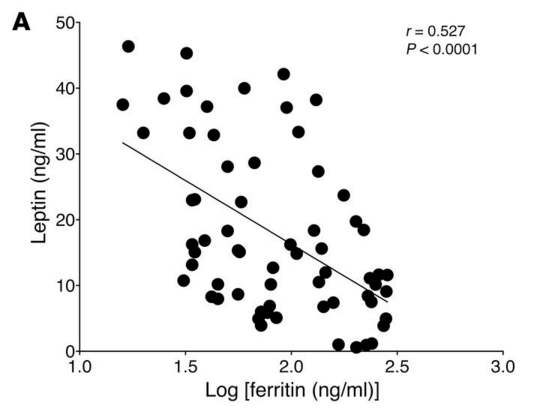
The ferritin values in the chart were all within the so-called normal range, so these are not extreme cases, but values found in healthy, non-iron-overloaded people. In otherwise healthy people, “normal” levels of iron can vary as much as 15-fold. As we'll see later, there are good reasons to believe that this is not normal at all.
When mice are fed a high-iron diet, their leptin levels decrease due to the effect of iron on fat cells.
Iron affects fat cells and hormones that control eating. More iron means less control of hunger.
So is it possible to lose weight by controlling the level of iron in the body, or by eating less iron from food?76
It would be premature to say so, but I consider it probable.
The chart below, from a U.S. government study on nutrients in the American diet, shows that iron consumption has increased dramatically in recent years.lxviii
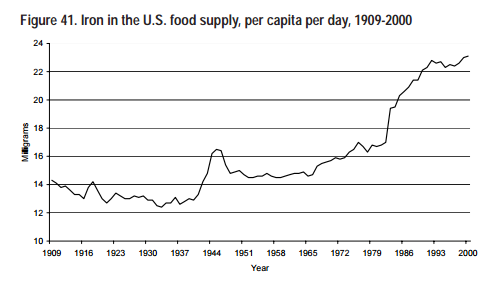
Could the huge increase in iron consumption in recent decades have anything 77to do with the obesity epidemic? If the obesity epidemic started in the early 1970s, then there's certainly quite a coincidence between rising iron intake and the rate of obesity.
Furthermore, sugar has taken much of the blame for the obesity epidemic; consumption of sugar and high-fructose corn syrup has gone up.
Sugar massively increases the uptake of iron by the cells of the intestines.lxix So sugar could lead to a higher iron load in the body, with lost control of hunger, leading to obesity.
If you want to lose weight, checking your body iron (ferritin) level would be a good idea, and if it's too high, steps can be taken to bring it down. The avoidance of high iron foods as well as food and drink that increase iron absorption, e.g. orange juice, is another good step. Certain dietary items such as green tea strongly inhibit iron absorption from food – this may be one of the reasons the Japanese stay slender.
All of this – what constitutes a high iron level, what foods are high in iron, how iron can be inhibited or removed – will be covered in the last chapter of this book.
Takeaway points
Serum (blood) levels of ferritin are associated with obesity
Iron causes derangement of hormones that control hunger
Iron intake has increased dramatically at the same time as obesity has gone up
Iron supplementation increases hunger; deficiency decreases it
References
- Iwasaki, Tomoyuki, et al. "Serum ferritin is associated with visceral fat area and subcutaneous fat area." Diabetes Care 28.10 (2005): 2486- 2491. ↩
- Gillum, R. F. "Association of serum ferritin and indices of body fat distribution and obesity in Mexican American men-the Third National Health and Nutrition Examination Survey." International Journal of Obesity & Related Metabolic Disorders 25.5 (2001). ↩
- Ukkola, Olavi, and Merja Santaniemi. "Adiponectin: a link between excess adiposity and associated comorbidities?." Journal of Molecular Medicine 80.11 (2002): 696-702. ↩
- Gabrielsen, J. Scott, et al. "Adipocyte iron regulates adiponectin and insulin sensitivity." The Journal of clinical investigation 122.10 (2012): 3529. ↩
- Facchini, Francesco S., Nancy W. Hua, and Riccardo A. Stoohs. "Effect of iron depletion in carbohydrate-intolerant patients with clinical evidence of nonalcoholic fatty liver disease." Gastroenterology 122.4 (2002): 931-939. ↩
- Bailey, Regan L., et al. "Dietary supplement use in the United States, 2003-2006." The Journal of nutrition (2010): jn-110. ↩
- Topaloglu, A. Kemal, et al. "Lack of association between plasma leptin levels and appetite in children with iron deficiency." Nutrition 17.7 (2001): 657-659. ↩
- Gao, Yan, et al. "Adipocyte iron regulates leptin and food intake." The Journal of Clinical Investigation 125.9 (2015): 3681-3691. ↩
- http://www.cnpp.usda.gov/sites/default/files/nutrient_content _of_the_us_food_supply/FoodSupply1909-2000.pdf ↩
- Christides, Tatiana, and Paul Sharp. "Sugars increase non-heme iron bioavailability in human epithelial intestinal and liver cells." PloS one 8.12 (2013): e83031. ↩
Keep going past iron
Iron is one lever, not the whole machine. P. D. Mangan writes every week about the rest of it: training, protein, insulin, sleep, and the research as it lands.
No charge, and you can unsubscribe at any time. You can also follow P. D. Mangan on X.