4 · Iron and Brain Diseases
Alzheimer's disease, Parkinson's disease, and dementia rank among the most dreaded diseases of old age. People fear them so much not because they are literally worse than, say, cancer, but because they seem to rob us of our identity. By causing the decline of brain function, our very selves melt away, until we're left helpless and a burden to others.
Brain iron and Alzheimer's disease
Alzheimer's disease is perhaps the most well known brain disorder. In this illness, the neurons in the brain become loaded with plaques that inhibit functioning.
Iron is intimately involved in the pathogenesis of Alzheimer's. High concentrations of iron are found in the plaques that characterize this disease.54l Furthermore, the accumulation of iron in the parts of the brain that are affected by Alzheimer's correlates with damage55.li
Oxidative stress, that is, an excess of free radicals that causes damage, is strongly associated with Alzheimer's disease.56lii Excess iron causes oxidative stress, providing a further mechanistic link.
Type 2 diabetes, which is characterized by insulin resistance, is a risk factor for Alzheimer's, and in fact this disease has been called “type 3 diabetes”. Diabetes can result in deregulation of iron metabolism leading to excess iron accumulation in the brain.
Brain iron, Parkinson's disease, and lifespan57
Parkinson's disease is a progressive brain disorder that affects movement. Its cause is the loss of neurons that produce dopamine in the substantia nigra, a region of the midbrain.5859
Parkinson’s, if not treated properly, can be fatal.60
According to Joseph Knoll, the Hungarian discoverer of the drug selegiline (Deprenyl), which is used to treat Parkinson’s, all humans lose on average 13% of their dopamine neurons per decade after the age of 45.
At that rate, if we lived long enough, everyone would develop Parkinson’s. The reason why some develop Parkinson's and others do not is because they lose neurons at a rate greater than 13% a decade. When dopamine neurons decline in number to about 30% of normal, the disease sets in, and when these neurons decline to 10% of normal, death occurs.
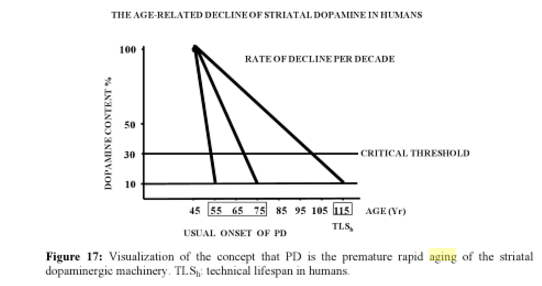
This chart, taken from Knoll's book, shows that with a steeper rate of decline of dopamine neurons, Parkinson’s occurs between the ages of 55 and 75, and that with a “normal” rate of decline, death from Parkinson's would occur for everyone at the age of 115. Dopamine neurons set a limit to human lifespan.
Deprenyl, the drug that Knoll discovered, both protects dopamine neurons from destruction and extends the lifespan of lab animals, which gives additional support to the idea that dopamine neurons set a limit on lifespan. In Knoll’s study on rats, those on Deprenyl lived 35% longer than controls. That’s a huge extension, comparable to calorie restriction.
Parkinson's disease is also associated with the accumulation of iron in the parts of the brain that this disease affects.liii
Besides extending lifespan in lab animals, Deprenyl protects the brain against excess iron.liv This means that iron causes the death of dopamine neurons and that protecting them from iron both protects against Parkinson's disease and decreases aging. Protecting the brain from the accumulation of excess iron is crucial for good brain health in older age as well as for life extension.
Men have higher rates of both Parkinson's and Alzheimer's, and men also accumulate more iron in the affected regions of the brain.lv Men also have higher levels of iron overall. Aging is also strongly associated with both diseases, and older people have more iron in their bodies than younger people.
Mild cognitive impairment, a precursor to Alzheimer's, is also characterized by iron accumulation in the brain.lvi61
Many researchers have noted the connection between iron accumulation and brain disorders, a62nd have therefore suggested therapies based on removing the iron. One review article suggested phlebotomy, the targeted removal of blood and lowering of iron stores, as a therapy for Alzheimer's.lvii A quote from the article summary:
Body iron stores that increase with age could be pivotal to AD [Alzheimer's disease] pathogenesis and progression. Increased store63d iron is associated with common medical conditions such as diabetes and vascular disease that increase risk for development of AD. Increased stored iron could also promote oxidative stress/free radical damage in vulnerable neurons, a critical early change in AD. A ferrocentric model of AD described here forms the basis of a rational, easily testable experimental therapeutic approach for AD, which if successful, would be both widely applicable and inexpensive. Clinical studies have shown that calibrated phlebotomy is an effective way to reduce stored iron safely and predictably without causing anemia. We hypothesize that reducing stored iron by calibrated phlebotomy to avoid iron deficiency will improve cerebrovascular function, slow neurodegenerative change, and improve cognitive and behavioral functions in AD.
Iron chelators, which are drugs or other natural chemicals that bind to iron and remove it, have also been sugg64ested for both Alzheimer's and Parkinson's.65
Catechins, which are substances found in green tea, have also been suggested as treatments for these brain diseases. These substances chelate iron and cross the blood-brain barrier, penetrating the brain to remove iron.lviii
Ferritin: dynamite in storage
At this point, let's digress a bit into the issue of free iron versus ferritin.66
As noted, iron is a highly reactive atom, much like oxygen, and therefore the body has developed mechanisms for controlling its reactivity, for “locking it down”, so that it becomes safer and less likely to do damage. The principal means that the body has for controlling iron is the protein molecule ferritin, which sequesters iron atoms in its core and makes them unavailable for reaction with other molecules.
Each ferritin molecule stores up to 4,500 iron atoms inside it.
As we age, ferritin levels tend to increase, reflecting the increase in iron stores that result from continued ingestion of iron and, in most cases, very little loss.
Also as we age, there's a tendency for free iron to increase. Essentially, the body becomes worse at being able to lock iron down with ferritin, and the amount of free iron in the system increases. This is an unhealthy situation.
In many cases of disease, such as in Alzheimer's and Parkinson's, the culprit doing the damage is free iron, not ferritin, or at least that's the current thinking. (Much remains to be learned about both iron metabolism and brain diseases.) Therefore the question arises as to whether lowering ferritin levels through phlebotomy will help decrease the risks of disease, or treat diseases when already present.
Part of the problem in Alzheimer's and Parkinson's may be due to disordered iron regulation. In other words, there may be something about the physiology of the brain in patients with those diseases that disposes it to higher levels of free iron.
Nevertheless, higher brain levels of ferritin, the iron-storage molecule, are also seen in patients with these diseases. Just having enough ferritin around may be enough to trigger the release of free iron, which then causes damage.
Excessive ferritin may be likened to having a box full of dynamite in your house; it's safe enough if that dynamite never gets near fire, but it's an accident waiting to happen. So generally, you don't want to keep a box of dynamite at home. The same applies to ferritin. Elevated levels of free radicals inside neurons and glial cells (the supporting cast in the brain) likely cause iron to be released from ferritin, like a match lighting a stick of dynamite.
So, even though ferritin is considered a safe form of iron, lowering its levels through phlebotomy or some other means decreases the amount of damaging free iron.
Furthermore, certain treatments can increase the amount of ferritin produced, and this is then available for the storage of iron, decreasing the amount of free iron in the system.
Such treatments include substances that cause hormesis, which occurs when the body activates molecular defense systems in reaction to certain stimulatory agents. Well known agents that work through hormesis include EGCG and other substances in green tea, curcumin, resveratrol, and others. Some of these may therefore be useful in preventing or treating Alzheimer's and Parkinson's.
Other agents that work this way include exercise and intermittent fasting, so staying lean and in shape could go a long way toward preventing the brain diseases of aging. These interventions also greatly decrease the risk of type 2 diabetes, which in turn decreases the risk of Alzheimer's.
Iron chelators' mode of action is to directly interact with free iron, not ferritin, and remove it. IP6 (inositol hexaphosphate), a molecule refined from rice bran, strongly chelates iron and removes it, and it has been suggested as a treatment in Parkinson's.lix In cell culture, IP6 significantly protects neurons, the cells of the brain.
We'll have much more to say on iron chelators later.
Takeaway points67
Both Alzheimer's and Parkinson's diseases are associated with high iron in the brain
Parkinson's disease is due to death of dopamine neurons, and this happens to everyone
Iron is also increased in mild cognitive impairment
Phlebotomy (bloodletting) may treat Alzheimer's
Ferritin can be degraded into free iron, which causes damage. It's biological dynamite
Iron chelators reduce free iron, the damaging kind
References
- Connor, J. R., et al. "A histochemical study of iron, transferrin, and ferritin in Alzheimer's diseased brains." Journal of neuroscience research 31.1 (1992): 75-83. ↩
- Raven, E. P., et al. "Increased iron levels and decreased tissue integrity in hippocampus of Alzheimer's disease detected in vivo with magnetic resonance imaging." Journal of Alzheimer's disease: JAD 37.1 (2013): 127. ↩
- Butterfield, D. Allan, Fabio Di Domenico, and Eugenio Barone. "Elevated risk of type 2 diabetes for development of Alzheimer disease: a key role for oxidative stress in brain." Biochimica et Biophysica Acta (BBA)-Molecular Basis of Disease 1842.9 (2014): 1693-1706. ↩
- Mandel, Silvia, et al. "Iron dysregulation in Alzheimer's disease: multimodal brain permeable iron chelating drugs, possessing neuroprotective-neurorescue and amyloid precursor protein- processing regulatory activities as therapeutic agents." Progress in neurobiology 82.6 (2007): 348-360. ↩
- Ayton, Scott, et al. "Ferritin levels in the cerebrospinal fluid predict Alzheimer/'s disease outcomes and are regulated by APOE." Nature communications 6 (2015). ↩
- Bartzokis, George, et al. "Prevalent iron metabolism gene variants associated with increased brain ferritin iron in healthy older men." Journal of Alzheimer's Disease 20.1 (2010): 333-341. ↩
- Pisa, Diana, et al. "Different Brain Regions are Infected with Fungi in Alzheimer's Disease." Scientific reports 5 (2015). ↩
- Weinreb, Orly, et al. "Targeting dysregulation of brain iron homeostasis in Parkinson's disease by iron chelators." Free Radical Biology and Medicine62 (2013): 52-64. ↩
- de Lima, Maria Noemia Martins, et al. "Selegiline protects against recognition memory impairment induced by neonatal iron treatment." Experimental Neurology 196.1 (2005): 177-183. ↩
- Bartzokis, George, et al. "Brain ferritin iron may influence age-and gender-related risks of neurodegeneration." Neurobiology of Aging 28.3 (2007): 414-423. ↩
- Smith, Mark A., et al. "Increased iron and free radical generation in preclinical Alzheimer disease and mild cognitive impairment." Journal of Alzheimer's disease: JAD 19.1 (2010): 363. ↩
- Dwyer, Barney E., et al. "Getting the iron out: Phlebotomy for Alzheimer's disease?." Medical Hypotheses 72.5 (2009): 504-509. ↩
- Mandel, Silvia, et al. "Green tea catechins as brain‐permeable, natural iron chelators‐antioxidants for the treatment of neurodegenerative disorders." Molecular nutrition & food research 50.2 (2006): 229-234. ↩
- Xu, Qi, Anumantha G. Kanthasamy, and Manju B. Reddy. "Neuroprotective effect of the natural iron chelator, phytic acid in a cell culture model of Parkinson's disease." Toxicology 245.1 (2008): 101-108. ↩
Keep going past iron
Iron is one lever, not the whole machine. P. D. Mangan writes every week about the rest of it: training, protein, insulin, sleep, and the research as it lands.
No charge, and you can unsubscribe at any time. You can also follow P. D. Mangan on X.