2 · Iron and Heart Disease
Coronary heart disease is a major scourge in the modern world. As noted in the first chapter, men have much greater rates of heart disease than women. Why is this?
For a long time it was thought that the difference was in sex hormones, which obviously differ greatly between men and women. Either female sex hormones like estrogen were protective, or male hormones like testosterone caused harm. That was the thinking anyway.
But in 1981, a doctor, Jerome Sullivan, first proposed that the difference between men and women in heart disease risk was due to iron in the body, of which men have more and women less.
In the Framingham Study, which studied a large group of people for many years, it was found that both natural menopause and hysterectomy increased the risk of heart disease in women. Therefore the answer to the increased rate of heart disease in men cannot be hormones.x29xix
The chart below shows the difference in rates of coronary heart disease by age, sex, and menopausal status.30xxx
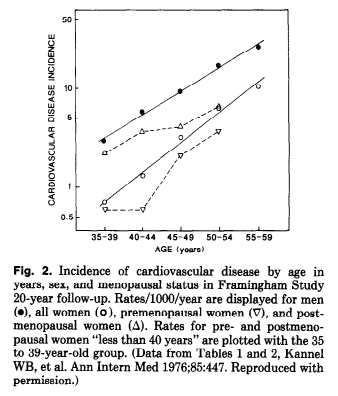
Men have higher rates of heart disease at any age, and post-menopausal women have much higher rates than pre-menopausal women, even at the same age. Hormone replacement therapy with estrogen does not protect post-menopausal women from heart disease.
Women who use the birth control pill have both higher iron levels and higher rates of heart disease.
Pre-menopausal women lose blood through their menstrual cycle, an average of about 35 milliliters a month, or about 420 milliliters a year. Since blood is the major storage tissue for iron, containing about 80% of the body's total, losing blood means losing iron. And in fact, pre-menopausal women do have much less iron in their bodies.
What about cholesterol? Haven't we been told for a long time to lower it and that it causes heart attacks? To see whether this is true take a look at the following chart:
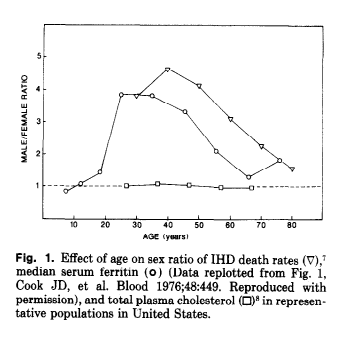
The chart shows the sex ratio in heart disease deaths by age, that is, the number of men divided by the number of women who have heart disease at any age. Also plotted is the sex ratio of the median ferritin (iron) level by age. Finally, at the bottom of the graph is the sex ratio of total cholesterol by age.
Cholesterol hardly matters. Men have both much higher ferritin levels than women, and a much higher rate of death from heart disease.
Among men alone, greater iron means more heart attacks. Those with a ferritin (a measure of iron) greater than 200, after adjusting for a host of factors, including age, cigarette pack-years, abnormal ECG in an exercise test, maximal oxygen uptake, systolic blood pressure, blood glucose, serum copper, HDL cholesterol, and triglyceride concentrations, men with ferritin greater than or equal to 200 had 2.2 times the risk of a heart attack than did those with ferritin less th31an 200.xxxi
Many, many men have a ferritin of 200 or more. Not a single laboratory even considers 200 to be abnormal. Your doctor doesn't consider 200 to be abnormal. (We'll discuss what is normal or abnormal for iron later on.)
Heart attacks show a strong circadian variation, and are three times more likely to occur at 9:00 A.M. than at 11:00 P.M. This pattern coincides with the variation in serum iron levels, which are two to three times higher in the morning than at night.
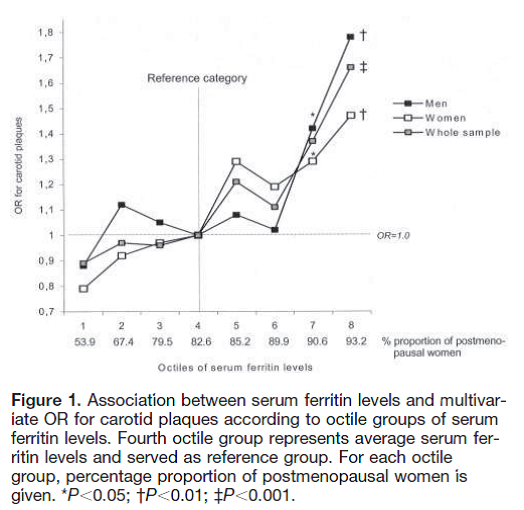
Carotid artery disease occurs when plaque builds up and narrows the opening of the arteries. The biological mechanism that causes this is similar to that which causes coronary artery disease. As ferritin (iron) increases, so does the risk of carotid artery disease. See the chart below.
How does iron block arteries? The mechanisms are unclear, but iron is highly reactive, and can damage lipids and other molecules, causing inflammation that leads to arterial plaque. Iron is increased in atherosclerotic lesions as compared with normal arterial walls.
Low iron also increases nitric oxide, an important factor in the protection of the walls of blood vessels.32xxxii
Statin drugs, iron and heart disease
Statin drugs can reduce the risk of heart disease, and it's widely thought that this is due to their influence on cholesterol. However, pre-menopausal women are largely protected from heart disease, regardless of their cholesterol levels. Hormone replacement therapy (HRT) in post-menopausal women improves lipid profiles, but fails to protect against atherosclerosis or heart attacks. Something besides cholesterol is causing heart disease.
Statins affect iron metabolism by clearing free iron. The use of statins is also associated with lower ferritin (iron) levels.33xxxiii
In a study that lowered iron via phlebotomy, some of the patients were taking statins. It was found that improved health outcomes were associated with lower ferritin values, but not with improved cholesterol (HDL and LDL).34xxxiv
Iron looks like a much more promising candidate as causative of heart disease than cholesterol.
The evidence that heart attacks are related to iron comes from disparate sources: experiments using lab animals or cell cultures, and epidemiological studies of the general population or of blood donors.35
As iron levels go up with age, the risk of heart attack also increases. Men have greater heart disease risk than women, and post-menopausal women greater risk than pre-menopausal. Iron damages arterial walls. Combine all of these and there's a clear case for the relation of excess iron to coronary heart disease.
Takeaway Points
The difference between men and women in heart disease risk is, at least in part, due to higher iron levels in men
In men alone, those with higher iron have more heart disease
In women, menopause results in both higher iron levels and rising rates of heart disease
In fertile (pre-menopausal) women, monthly blood loss means lower iron levels than men, along with much lower risk of heart attack
High iron levels are associated with carotid artery plaque
Iron is a highly reactive metal and can damage arterial walls
References
- De Valk, B., and J. J. M. Marx. "Iron, atherosclerosis, and ischemic heart disease." Archives of Internal Medicine 159.14 (1999): 1542-1548. [Much of the chapter on heart disease is based on this paper.] ↩
- Sullivan, Jerome L. "The iron paradigm of ischemic heart disease." American Heart Journal 117.5 (1989): 1177-1188. ↩
- Salonen, Jukka T., et al. "High stored iron levels are associated with excess risk of myocardial infarction in eastern Finnish men." Circulation 86.3 (1992): 803-811. ↩
- Sullivan, Jerome L. "Are menstruating women protected from heart disease because of, or in spite of, estrogen? Relevance to the iron hypothesis." American Heart Journal 145.2 (2003): 190-194. ↩
- Mascitelli, L., and M. R. Goldstein. "Might the beneficial effects of statin drugs be related to their action on iron metabolism?." QJM 105.12 (2012): 1225-1229. ↩
- Zacharski, Leo R., et al. "The statin-iron nexus: anti-inflammatory intervention for arterial disease prevention." American Journal of Public Health 103.4 (2013): e105-e112. ↩
- Lauffer, R. B. "Iron stores and the international variation in mortality from coronary artery disease." Medical Hypotheses 35.2 (1991): 96-102. ↩
Keep going past iron
Iron is one lever, not the whole machine. P. D. Mangan writes every week about the rest of it: training, protein, insulin, sleep, and the research as it lands.
No charge, and you can unsubscribe at any time. You can also follow P. D. Mangan on X.